


Israel Made Bobsled Debut Along with Another Sport on the Same Track with Skeleton
Israel made History in Men’s Bobsled as they participated in the 2 Men Bobsled and 4 Men Bobsled


Highlights of Israel's bobsleigh runs at the 2026 Winter Olympics in Milano Cortina focused on the historic debut, emphasizing participation, resilience, and moments of pride over raw performance.
Two-Man Bobsleigh (Edelman piloted with brakeman Menachem Chen)
The team completed three runs (heats 1–3 on February 16–17, 2026), as only the top 20 advanced to a fourth heat Israel did not qualify, finishing 26th out of 26 with a cumulative time of 2:52.24 (7.45 seconds behind the leaders).
They had the slowest starts and finishes in the early heats, trailing significantly (nearly 5 seconds behind the leader at midway after two runs). Despite last place, the duo celebrated wildly high-fives, smiles at the finish line, and Edelman declaring "Israel is in the Olympics, baby!" They viewed qualification and showing up as the true victory, overcoming massive hurdles like fundraising and limited training. Edelman highlighted the journey as proof of perseverance for Israeli winter sports. They didnt care about what place they finisjed, and only cared about the fun experince of the sport as they made Isarel very proud to avocate the Israel can also participate in the Winter Games.
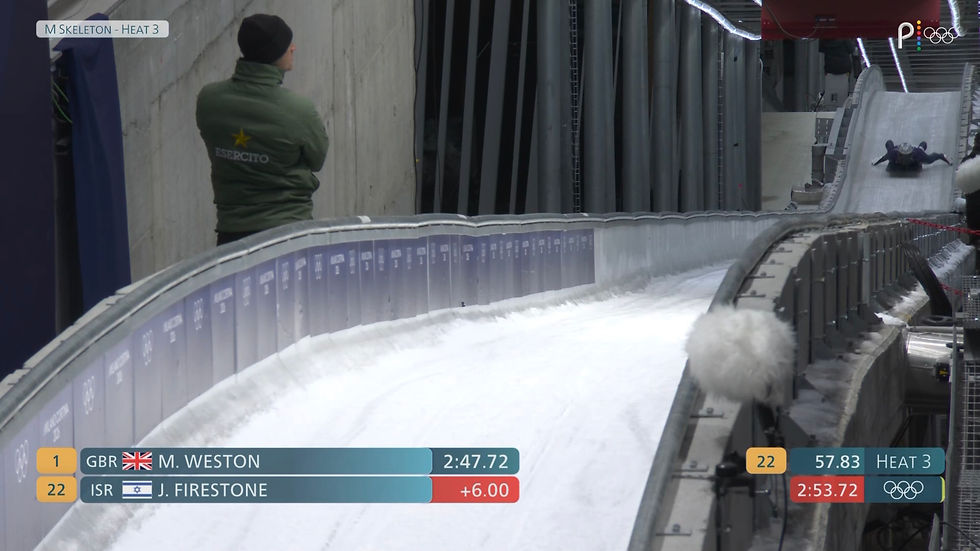
Men's Skeleton (Jared Firestone) at the 2026 Winter Olympics in Milano Cortina marked a solid Olympic appearance for Israel's second-ever skeleton competitor (following AJ Edelman in 2018). Nicknamed the "Jewish Jet," the 35-year-old Florida-born attorney and Tulane alum competed in all four heats (February 12–13, 2026, at the Cortina Sliding Centre), finishing 22nd out of 24 athletes with a total time of 3:51.35 (+8.02 seconds behind gold medalist Matt Weston of Great Britain).
Individual Heat Times and Rankings (from official results): Run 1 (Feb 12): 58.15s (23rd place), Run 2 (Feb 12): 57.74s (22nd place), Run 3 (Feb 13): 57.83s (22nd place), Run 4 (Feb 13): 57.63s (23rd place)
Firestone's times hovered around 57–58 seconds per run, consistently near the back of the pack but showing slight improvement in the final heat (his fastest of the competition). He achieved a top speed of about 121.86 km/h in Run 2 (one of his better segments). Start times were in the 4.7–4.8 second range, reflecting the challenges of equipment, experience, and the icy track conditions.
Key Highlights:
Firestone qualified for all four runs (top 20 advanced to Run 4 for medal contention, but he stayed in the field as skeleton allows all starters to complete four without getting disqualified). He described the experience as a storybook ending" and "dream come true," especially as one of Israel's flagbearers at the opening ceremony. In post-competition messages, he expressed gratitude to supporters in Israel and excitement for life after sliding (noting this would likely be his last competitive run after a decade-long pursuit). Despite finishing near the bottom, he emphasized pride in representing Israel, Jewish resilience, and overcoming logistical/financial barriers with no domestic winter facilities. The event was dominated by Matt Weston (GBR), who set multiple track records en route to gold (3:43.33 total). This performance built on Israel's growing (if modest) winter sports presence, with Firestone delivering consistent slides and positive spirit amid tough competition. No medals for Israel in skeleton or any Winter event historically, but moments like this highlight perseverance and representation.



Four-Man Bobsleigh (Edelman pilot, with Menachem Chen, Uri Zisman, and Omer Katz)
The team ran the first two heats on February 21, 2026 (Shabbat), Combined time after two runs: 1:51.16 (+2.55 seconds behind the leader at that point), placing them 24th out of 27 sleds (last among those who completed both runs cleanly).
Highlights included a strong recovery in run 2 after an early mistake in run 1, achieving the 9th-best top speed of that heat (around 135 km/h).
Edelman posted enthusiastically about the team "crushing it" despite the position, noting the debut on Shabbat and calling it "impossible becoming reality" under the "Shul Runnings" banner. The squad was set for a third heat on February 22 but withdrew themselves before it due to the substitution controversy (attempting to include alternate Ward Fawarseh by falsely claiming illness for Zisman), resulting in DNS. No further runs occurred.
These runs etched Israel's name in Olympic history as the first bobsleigh participation ever no top finishes, but huge symbolic wins in representation, team spirit, and breaking barriers for a country with almost no winter facilities. Edelman and the team stayed positive, focusing on pride and the bigger picture. Despite the disappointment by the media and early leave of the copetiton, Isarel kept focused and supported their country to make them feel proud to represent the sport of Bobsled and had a good run on their Debut Appearance which they'll hopefully comback stronger in the 2030 Winter Olympics.


Comments